

Pushpam Priya Choudhary is an Indian politician from Darbhanga, Bihar, who has gained attention for her bold and reformist approach to politics. Born on 13 June 1987, she is the founder of The Plurals Party, a political outfit that aims to move beyond caste and religion-based politics and focus instead on development, merit, and modern governance.
Educated at prestigious institutions such as Symbiosis International University in Pune, the University of Sussex in the UK, and the London School of Economics, she returned to Bihar with a vision to transform the state. In 2020, she contested the Bihar Assembly elections from Bisfi, Madhubani, and in 2025, she contested again from Darbhanga, her hometown.
Early Life and Background
Pushpam Priya was born on 13 June 1987 in Darbhanga, Bihar. Growing up in this historic city, she was surrounded by a mix of tradition and modernity. Darbhanga, known for its cultural richness and political importance, played a big role in shaping her early worldview. Her childhood was not just about school and play; it was also about listening to discussions on politics, journalism, and social issues at home.
Her family background also meant that she was exposed to public life from a young age. With her father being a journalist and her grandfather and uncle involved in politics, she grew up in a household where debates about governance, democracy, and development were common. This early exposure planted the seeds of political ambition in her, even though she would later take a long academic journey before stepping into politics herself.
Pushpam Priya Choudhary – Wiki Table
| Attribute | Details |
|---|---|
| Full Name | Pushpam Priya Choudhary |
| Profession | Politician |
| Known For | Founder and President of The Plurals Party |
| Date of Birth | 13 June 1987 (Saturday) |
| Age (as of 2025) | 38 Years |
| Birthplace | Darbhanga, Bihar, India |
| Zodiac Sign | Gemini |
| Nationality | Indian |
| Religion | Hinduism |
| Hometown | Darbhanga, Bihar |
| Height (approx.) | 5′ 7″ (170 cm) |
| Weight (approx.) | 50 Kg (110 lbs) |
| Eye Colour | Brown |
| Hair Colour | Black |
| School | Holy Cross Missionary School, Darbhanga |
| College/University | • Symbiosis International University, Pune • Institute of Development Studies, University of Sussex, UK • London School of Economics and Political Science (LSE), UK |
| Educational Qualification(s) | • Bachelors in Communication Design (2007–2011) • MA in Development Studies (2015–2016) • Master of Public Administration (2017–2019) |
| Political Party | The Plurals Party |
| Political Journey | • 2020: Contested Bihar Legislative Assembly elections from Bisfi, Madhubani (lost) 2025: Contested Bihar Legislative Assembly elections from Darbhanga |
| Marital Status | Unmarried |
| Parents | Father – Binod Kumar Choudhary (Journalist) Mother – Not publicly known |
| Siblings | Elder Sister – Civil servant in the UK |
| Other Relatives | • Grandfather – Umakant Chaudhary (Founding member of Samata Party) • Uncle – Vinay Kumar Choudhary (MLA from Benipur) |
| Hobbies | Reading, Traveling |
| @pushpampc13/ |
Family Heritage and Political Lineage
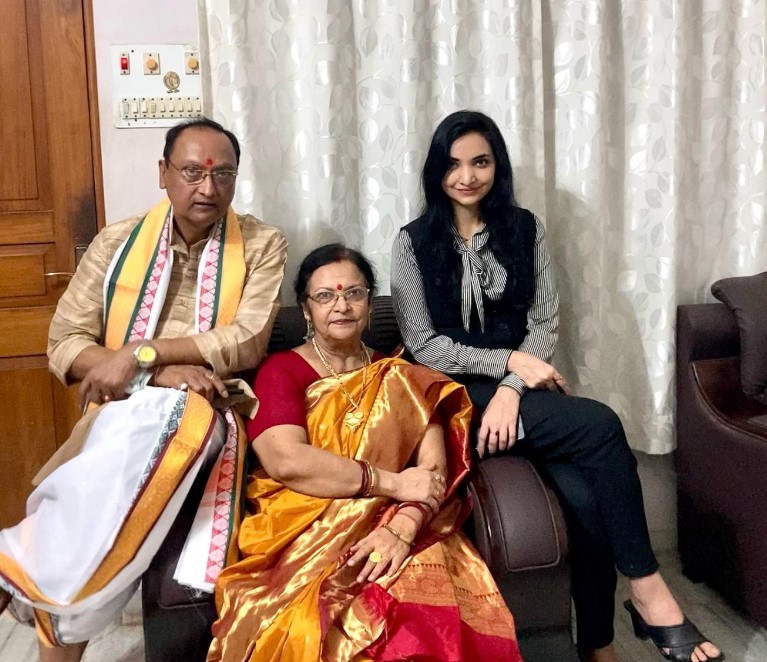
Pushpam comes from a family where politics and public service are part of the DNA. Her grandfather, Umakant Chaudhary, was one of the founding members of the Samata Party, a political outfit that played a key role in Bihar’s political history. His involvement in shaping the party gave the family a strong presence in the state’s political circles.
Her uncle, Vinay Kumar Choudhary, also carried forward this legacy by serving as an MLA from Benipur. This meant that politics was not just a distant subject for her; it was something she saw up close, through family discussions, campaigns, and the responsibilities that come with public life.
Her father, Binod Kumar Choudhary, worked as a journalist. This gave her a unique balance of perspectives — on one side, the political world of her grandfather and uncle, and on the other, the journalistic values of truth, accountability, and questioning authority. This combination shaped her into someone who could see both the strengths and weaknesses of politics in Bihar.
Physical Appearance
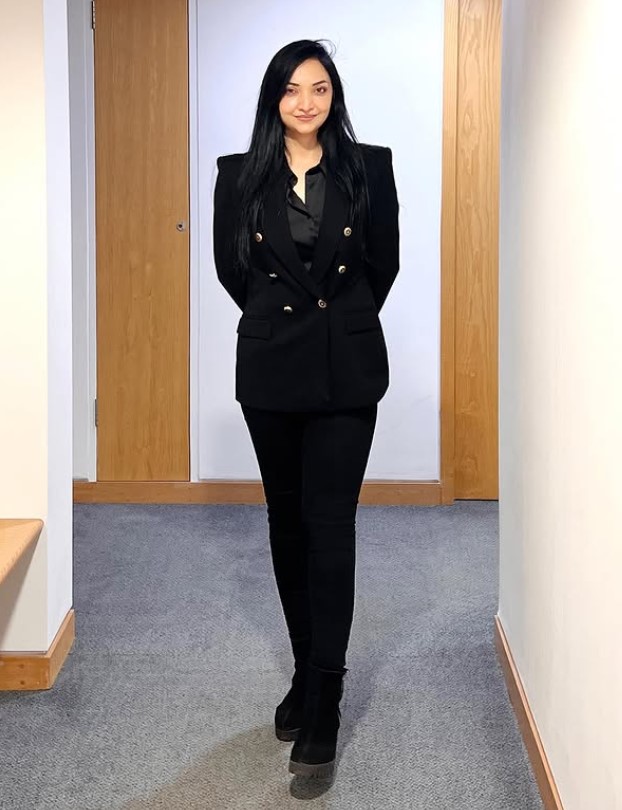
Pushpam stands at 5 feet 7 inches (170 cm) and weighs around 50 kg (110 lbs). She has brown eyes and black hair, features that add to her striking presence.
Her choice of attire has often been a subject of discussion. During her campaigns, she was frequently seen in black outfits, paired with a mask, which became her signature look. This not only made her stand out but also gave her a distinct identity in the crowded political space.
Education and Academic Excellence
Pushpam Priya completed her schooling at Holy Cross Missionary School in Darbhanga. This early education gave her a strong foundation in academics and discipline. Teachers and peers often recall her as a bright student with leadership qualities. She pursued a Bachelor’s degree in Communication Design at Symbiosis International University, Pune (2007–2011). This gave her exposure to creativity, design thinking, and communication — skills that would later help her in political campaigns.
She then went abroad for higher studies. At the University of Sussex (2015–2016), she completed her MA in Development Studies, where she studied global development issues, governance, and policy-making. Later, she joined the London School of Economics and Political Science (2017–2019) for a Master of Public Administration (MPA). This program trained her in leadership, economics, and public policy, preparing her for a career in governance.
Professional Journey
Before entering politics, Pushpam Priya explored professional opportunities that aligned with her education. While details of her early career are not widely publicized, her background in communication design and development studies suggests that she worked in areas related to policy, governance, or creative communication.
Her years in the UK exposed her to international systems of governance. She interacted with diverse groups of people, studied real-world case studies, and learned how governments in other countries tackled issues like poverty, inequality, and development.
Despite having the option to build a career abroad, she chose to return to Bihar. This decision was driven by her desire to bring change to her home state. She believed that her education and exposure would be wasted if she did not use them to improve the lives of people in Bihar. This marked the beginning of her political journey.
See Also:- AsmrLinastar (YouTube Star) Height, Biography, Age, Boyfriend, Family
Founding of The Plurals Party
In 2020, Pushpam Choudhary made a bold move that instantly caught national attention. She announced the launch of her own political party, The Plurals Party, and declared herself a Chief Ministerial candidate for the Bihar Assembly elections. This was not a small step. In a state where politics is dominated by long-standing parties and powerful leaders, her decision to enter the race as an independent reformist was both daring and unconventional.
The Plurals Party was built on the idea of breaking away from caste-based and religion-driven politics. Instead, it focused on development, merit, and governance. Her campaign slogan and vision were centered on creating a Bihar that could compete with the most developed states in India. She wanted to bring in a new kind of politics — one that was modern, transparent, and people-focused.
Political Journey and Elections
In the 2020 Bihar Assembly elections, she contested from Bisfi, Madhubani. Despite her strong campaign and media attention, she lost the election. However, the loss did not discourage her. Instead, it gave her valuable experience about the ground realities of Bihar politics. She realized that while her ideas were appealing to educated youth and urban voters, rural areas still leaned heavily on traditional political loyalties.
By 2025, she was back in the political arena, this time contesting from Darbhanga, her hometown. This move was strategic, as Darbhanga was not only her birthplace but also a place where her family had strong political roots. Her campaign once again focused on development and reform, and she positioned herself as a leader who could bring real change to Bihar.

Personal Life and Marital Status
One of the most searched questions about Pushpam Priya Choudhary is about her marital status. As of 2025, she is unmarried. Despite rumors and speculation that often surround public figures, she has remained focused on her career and political journey. She has not spoken publicly about any relationships, and her personal life has largely stayed away from the spotlight.
Her decision to remain unmarried at 38 has often been discussed in the media, but she has made it clear through her actions that her priority is her political career and her vision for Bihar. In a society where women are often judged by their marital status, her choice reflects independence and determination. She has shown that women can define their own paths without conforming to traditional expectations.
Hobbies and Interests
One of her favorite hobbies is reading. She has often spoken about how books have shaped her thinking and broadened her perspective. From political theory to development studies, her reading habits reflect her intellectual curiosity and commitment to learning.
She also enjoys travelling, which has given her exposure to different cultures and governance systems. Her time abroad for studies allowed her to travel across Europe and experience how societies function differently. These experiences have influenced her vision for Bihar, as she often draws comparisons between global practices and local challenges.

Controversies and Criticisms
When Pushpam Priya Choudhary declared herself a Chief Ministerial candidate in 2020, it was seen as a bold but controversial move. Many critics argued that she lacked political experience and underestimated the complexities of Bihar’s electoral system. Established parties dismissed her as a political novice, while some accused her of being disconnected from ground realities because of her years abroad.
As a woman in Bihar politics, she has also faced gender-based criticism. Some opponents questioned her ability to lead simply because she was a woman, reflecting the deep-rooted biases that still exist in Indian politics. Despite this, she has continued to push forward, using criticism as motivation rather than a setback.
Her critics often portray her as elitist, pointing to her foreign education and lifestyle. They argue that her ideas, while progressive, may not resonate with rural voters who prioritize caste and community ties. However, her supporters counter this by saying that Bihar needs exactly this kind of modern, merit-based leadership to break free from its past.
Achievements and Contributions
One of her biggest achievements is the creation of The Plurals Party. In a state dominated by a few major parties, launching a new political outfit was a remarkable step. It gave young and educated Biharis a platform to voice their aspirations for development and reform.
Her campaigns have inspired many young people to take an interest in politics. By speaking about jobs, education, and governance, she has shifted the conversation away from caste and religion. This has encouraged a new generation of voters to think differently about leadership.
Read Also:- Madison Haschak (YouTuber) Height, Biography, Age, Boyfriend, Family
